Delftia in Big Numbers
Small microbes. Big questions. Beyond gold.
One genus. Many research questions.
🧬
Genomes
What can DNA reveal about different Delftia strains?
🌱
Microbial interactions
How do plant-associated bacteria acquire nutrients?
🔬
Shared discovery
How can students and communities contribute?
Gold biomineralization is one part of the story—not the whole organism. [2–6]
6.27 million DNA letters
Draft genome of D. tsuruhatensis MTQ3, isolated from the tobacco rhizosphere—the soil around roots. [4]
Mb = million base pairs. A genome is a starting point for testing what a microbe can do—not proof of every predicted function.
2 strains, different genome reports
MTQ3 · 6.27 Mb
Draft genome; isolated from the tobacco rhizosphere. Described as a plant growth-promoting rhizobacterium. [4]
HA60 · about 6.92 Mb
Complete circular chromosome; isolated from a commercial nano-hydroxyapatite product. [7]
Both are D. tsuruhatensis. These reports used different methods: two isolates do not define every strain, and isolation context does not prove a biological capability.
3 genes connected to iron acquisition
A study of MTQ3 used gene knockouts to identify three nonribosomal peptide synthetase genes involved in siderophore production. [5]
🧬 ### Genes Test a gene’s contribution by disrupting it.
⚗️ ### Molecules Siderophores bind iron.
🌱 ### Interactions Ask how iron acquisition affects life around roots.
This is evidence for a studied strain, not a universal trait of Delftia.
2025 · “Where is Delftia?”
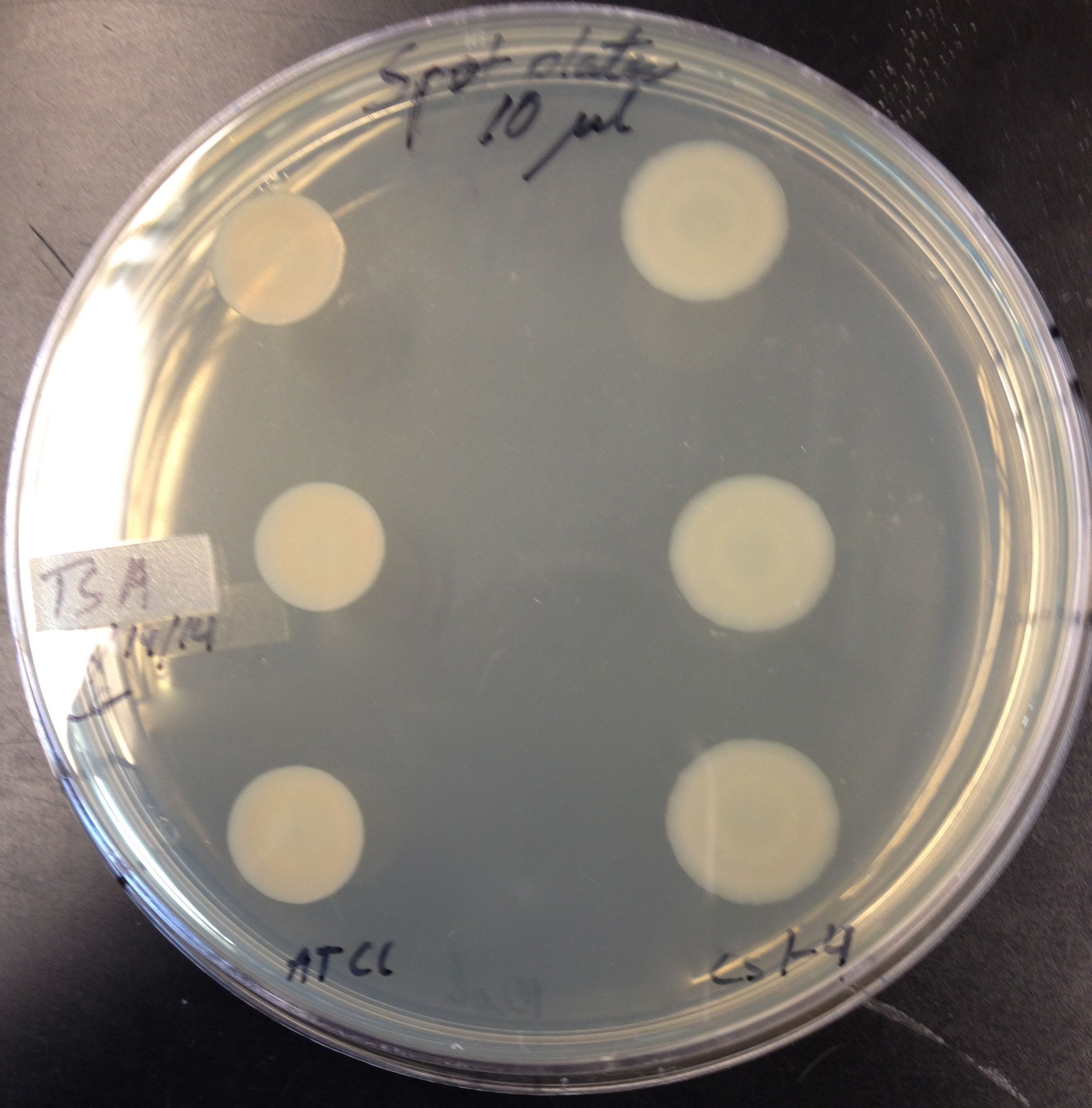
A 2025 education publication brings citizen science into biotechnology and environmental science curricula. [6]
Students also helped discover gold-precipitating bacterial lineages in earlier work. [3]
Observe → investigate → share
The next big question can start in a classroom.
62 million metric tonnes
The world’s electronic waste in 2022. [1]
This global challenge is one motivation for studying new approaches to material recovery—not a measure of what Delftia can recycle.
22.3% formally collected and recycled
22.3% documented · 77.7% not documented [1]
“Not documented” does not mean all was dumped: informal handling and tracking gaps also matter.
Responsible collection and recycling matter today, while researchers investigate future possibilities.
Gold is one remarkable example
1 · Dissolved gold
Gold can be toxic to bacteria.
2 · Delftibactin
D. acidovorans releases a molecule that binds gold.
3 · Solid particles
Gold changes form; it is not created from nothing. [2]
A laboratory finding, not a proven e-waste solution. This does not establish safe, cheap recovery from mixed electronics at industrial scale.
Big questions need many perspectives
Genomes + microbial interactions + community science
Delftia gives us more to investigate than gold alone.
Works cited · gold, e-waste & learning
- Baldé CP, et al. The Global E-waste Monitor 2024. International Telecommunication Union and United Nations Institute for Training and Research, 2024. Read the report.
- Johnston CW, Wyatt MA, Li X, Ibrahim A, Shuster J, Southam G, Magarvey NA. “Gold biomineralization by a metallophore from a gold-associated microbe.” Nature Chemical Biology. 2013;9:241–243. doi:10.1038/nchembio.1179.
- Riley NG, Goller CC, Leggett ZH, Lewis DM, Ciccone K, Dunn RR. “Catalyzing rapid discovery of gold-precipitating bacterial lineages with university students.” PeerJ. 2020;8:e8925. doi:10.7717/peerj.8925.
Works cited · beyond gold
- Hou et al. “Draft Genome Sequence of Delftia tsuruhatensis MTQ3, a Strain of Plant Growth-Promoting Rhizobacterium Isolated from Tobacco Rhizosphere.” 2015. PubMed: 26251486.
- Guo H, Yang Y, Liu K, et al. “Comparative Genomic Analysis of Delftia tsuruhatensis MTQ3 and the Identification of Functional NRPS Genes for Siderophore Production.” 2016. doi:10.1155/2016/3687619.
- Spence PL, Goller C, Riley N, Norman D, Leggett Z. “Where is Delftia? Implementing citizen science into the biotechnology and environmental science curriculum.” J Microbiol Biol Educ. 2025;26(1):e00088-24. doi:10.1128/jmbe.00088-24.
- Wang et al. “Complete genome sequence of Delftia tsuruhatensis strain HA60 isolated from a commercial nano-hydroxyapatite product.” 2024. doi:10.1128/mra.00171-24.